How Do I Keep My Business Documents Up to Date in 2026?
Maria runs a landscape design business in Vancouver. She spends 70% of her week on admin and client communication — and half of that time is hunting for the current version of something. Here is what living documents and AI watermarking actually change.
The Document Problem Nobody Treats as an Emergency
Here is a scene that plays out in thousands of small businesses every week. Maria needs to send a client a proposal. She opens the folder where the last proposal template lived. There are seven versions. She opens the most recent one — except the pricing on it is from January, and she raised her hourly rate in April. She edits it manually, hoping nothing else changed. She sends it. The client asks a question the proposal doesn't answer. She has to go back to the job notes, then to the supplier quote, then to the original email. Forty minutes for one document that should take four.
This is not a Maria problem. It is a structural problem with how most businesses treat documents: write once, forget, re-discover painfully. The Admin Burden Index 2026 — a survey of 5,000 UK and US office workers — estimates avoidable admin costs businesses $954 billion a year, and routine admin still dominates the workday across every organisation [1]. When workers spend their day managing the process of work instead of doing the work, that is not a productivity footnote. That is the business.
Why This Is Changing Right Now (Three Forces)
Three things collided in 2025-2026 that turn "nice-to-have document hygiene" into a competitive requirement.
1. The law changed. For real.
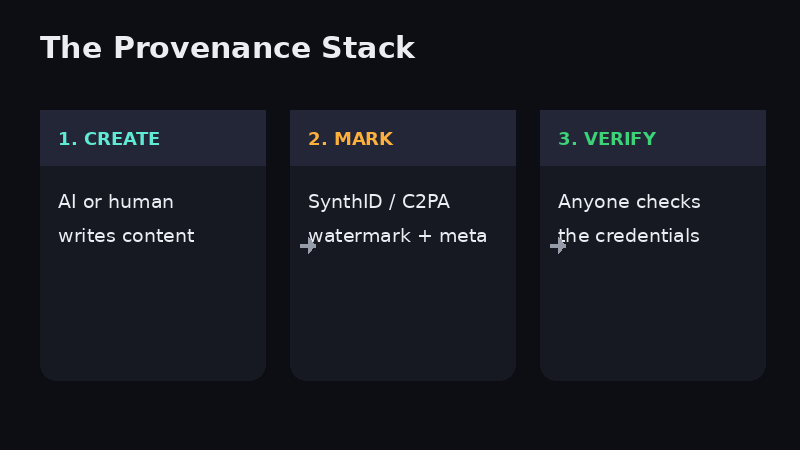
Article 50 of the EU AI Act — the transparency rule that requires AI-generated content to be marked and detectable — became enforceable on August 2, 2026 [2]. This is not a proposal. It is in force. If your business publishes AI-generated text, images, or video for EU audiences, you now have a legal obligation to label it. Anthropic has already rolled out invisible watermarking on Claude text output globally, driven directly by this rule [3]. Google's SynthID embeds watermarks in images, audio, text and video [4]. OpenAI has adopted SynthID and C2PA content credentials for its generated images [5]. The marking of machine-made content is now the default posture of every major AI vendor — and the businesses that use those tools inherit the obligation to understand what that means.
2. The search bar stopped being a list of links.
Google's AI Overviews are now the default, and the classic "ten blue links" format is deprecated — Google I/O 2026 introduced the Intelligent Search Box powered by Gemini [6]. Siri answers from Apple Intelligence. Perplexity and ChatGPT Search answer directly. What all of these systems have in common: they reward documents that are current, structured, and machine-readable — and they punish stale, unstructured, keyword-stuffed pages. A business whose documents are living and well-structured gets cited; one whose pages were written in 2021 and never touched disappears from the answer entirely. Voice search makes this brutal: people ask "how do I keep my business documents up to date" and expect a direct answer, not a link to a folder.
3. Content provenance became a product category.
C2PA — the Coalition for Content Provenance and Authenticity, backed by Adobe, Microsoft, Google, OpenAI, Intel and the BBC — publishes the open standard for content credentials: cryptographic metadata that records who created a file and what edits it went through, like a nutrition label for digital content [7]. Verification tools are becoming a product category: newsrooms, law firms, insurers, ad platforms, marketplaces and banks all need to know whether the content in front of them is real, generated, or altered [8]. For a small business, the practical version is simpler: know which of your documents are AI-assisted, label them honestly, and keep a version trail anyone can follow.
What Is a Living Document, Exactly?
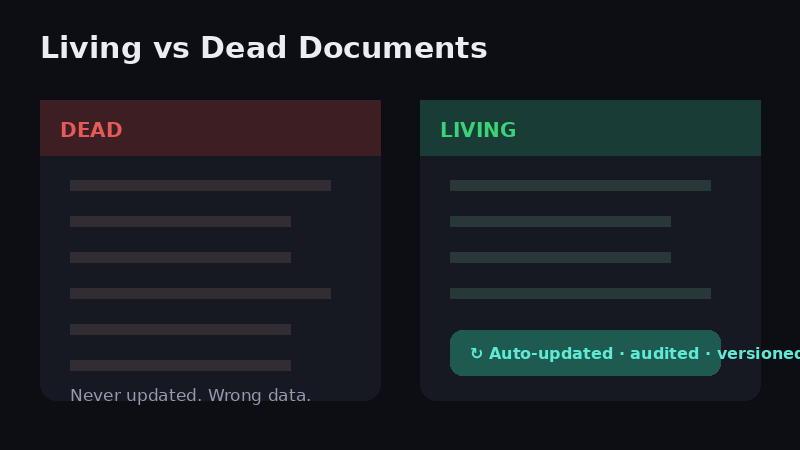
A living document is one that is continually updated as new information becomes available — instead of being written once and left to rot. The term comes from a formal academic method: living systematic reviews, developed by the Cochrane collaboration, are reviews that are continually updated as new evidence emerges, specifically designed to solve the currency problem of static research [9][10]. The same logic applies to business documents.
Examples of documents that should be living:
- Pricing sheets and rate cards — change every time your costs or positioning change
- Process and operations manuals — change every time you improve the way you work
- Policies (leave, expenses, safety) — change with regulations and practice
- Project plans and roadmaps — change every week by nature
- Client onboarding documents — change with your service catalogue
Examples of documents that should NOT be living:
- Signed contracts — a contract you keep editing is a contract you have broken
- Certificates and compliance records — these are evidence, not reference material
- Final reports — a report's value is that it captures a moment
- Regulatory filings — frozen by law
The discipline is to know which is which — and the cost of getting it wrong is real. A document you version-control that should be frozen creates legal exposure. A document you freeze that should be living creates operational rot. Living is a design decision, not a default.
Why Implement Living Documents (The Case For)
You stop paying the search tax
Every minute spent finding or re-deriving the current version of a document is time stolen from revenue. The Admin Burden Index puts the annual cost of avoidable admin at $954 billion across the UK and US [1]. Versioned shared storage with one canonical copy eliminates the "seven versions of the proposal" problem at its root.
Your team and clients stop tripping over stale facts
Outdated pricing loses money on every quote. Outdated safety policies create liability. Outdated onboarding documents confuse every new client. A living document with an owner and a review date converts "I think this is current" into "I know this is current."
AI search rewards currency
Google AI Overviews, Siri, and Perplexity prefer current, structured, well-sourced content. Pages and documents with visible update dates and clear structure get cited; stale ones disappear from answers [6]. For a service business, being the answer to "how do I..." queries is the new front door.
Provenance is becoming the law
EU AI Act Article 50 (enforceable August 2, 2026) requires AI content to be marked [2]. Living documentation practices — version history, labels, audit trails — are the same infrastructure you need to comply. You build it once, and it serves both operations and regulation.
The Counterpoints (When NOT to Do It)
"This is just more admin. I don't have time."
Fair — and the fix is not more manual discipline. The fix is automation: versioned shared storage (Google Workspace, Microsoft 365) does the version tracking for you; AI workflows regenerate predictable sections; the human reviews instead of re-types. The goal is to reduce admin, not add a process on top of a process. If a document takes more time to maintain than it saves, it should not be living — that is the honest test.
"My documents are fine. We know where everything is."
This is true until it isn't — the day the key person is off sick, the day a client asks for a version history, the day an auditor asks who approved the current policy. The businesses that say this are usually the ones with seven versions of the proposal in a folder. The audit in the HowTo section takes under an hour and tells you the truth.
"Watermarking AI content will make us look cheap or automated."
Nobody sees a watermark unless they look for it — most implementations are invisible to humans and detectable by machines. What customers and AI systems do see is honesty: a business that labels its AI-assisted content looks transparent, and transparency is trust. Under Article 50, hiding the label is the risky move, not the other way round [2][3].
"This is a big project. We'll do it next quarter."
It is not a big project. It is a one-hour audit, a naming of owners, and a migration of the ten documents you actually use into versioned storage. The next quarter version of this plan is what your competitors will be doing while you keep searching folders.
"AI watermarking is not reliable enough to matter."
Correct that watermarks are not perfect — rewriting can strip text watermarks, and detectors have false positives [11]. But the standard is not perfection; it is detectability and attribution. C2PA content credentials survive editing because they are cryptographic metadata, not a statistical signal [7]. The point is to raise the cost of faking and to give honest businesses a way to prove their work — which is exactly what provenance is for.
"We don't use AI, so we don't need watermarking or provenance."
Not quite. Even if you never generate content with AI, you still receive it: supplier documents, client materials, marketing assets, images. Provenance is how you tell what is real and what was machine-made — and how you protect your own brand from being faked. A competitor or scammer can generate content in your name today; C2PA-style credentials are the mechanism for proving it is not yours [7]. Ignoring provenance because you don't generate AI content is like ignoring locks because you don't steal.
The Case Studies (What Actually Happens)
A US logistics firm implemented AI document processing and cut document-processing time by 87.3%, saving 40 hours per week, with a measured 217% ROI over an 11-week implementation. The workflow: AI reads incoming documents, extracts the data, routes them to the right place, and flags exceptions for humans [12]. The documents became living — every version searchable, every data point extractable — without anyone changing their working habits.
The Cochrane Collaboration formalised living systematic reviews so that medical evidence stays current as new trials publish [9][10]. Their published rationale is exactly the business case: currency is a quality problem, not an inconvenience. Reviews that go stale mislead decisions — and so do business documents. The method that keeps medical evidence trustworthy is the same method that keeps your price list trustworthy.
Anthropic now watermarks Claude text output globally, driven by EU AI Act Article 50 compliance [3]. Google's SynthID watermarks images, audio, text and video, and Chrome can surface C2PA/SynthID info when you verify an image's origin [4][5]. OpenAI adopted SynthID + C2PA for generated images [5]. The entire AI industry is converging on: mark machine content at creation, verify it at consumption. Businesses that align with this now are building the trust infrastructure their competitors will be forced to build later.
DMS vendors' ROI methodology research is unusually candid: the largest costs a document system eliminates are invisible — time spent searching, labour absorbed by manual data entry, compliance exposure from disorganised records [13]. Because the costs are invisible, most owners underweight the benefit and skip the upgrade. The research argues the ROI case has to count avoided risk, not just saved minutes.
The Pros and Cons, Laid Flat
| Living Documents | AI Watermarking / Provenance | |
|---|---|---|
| What it solves | Stale info, search tax, version chaos | Fake content, attribution, AI disclosure law |
| Main benefit | Currency: you act on what is true | Trust: you can prove what was made by whom |
| Main cost | Maintenance discipline (mitigate with automation) | Tooling + knowing when to label |
| When it pays | Documents that change monthly or more | Any AI-generated content that goes public |
| When it hurts | Stable records versioned unnecessarily | Over-labeling content nobody asked about |
| Verification | Owner + review date + version history | Content credentials (C2PA) + watermark check |
Voice Search and AI Answers: The New Front Door
Here is the shift most small businesses have not internalised yet. When a customer used to search, they typed three words into Google and picked from a list of links. Now they say a full sentence to Siri, or type a complete question into Perplexity, and they get one answer — not ten links. "How do I keep my business documents up to date?" "Can AI help organize business documents for a landscape company?" "What is AI watermarking and do I need it?" These are the actual queries behind this article, and they are the shape of the searches your future customers will make.
The consequence is structural. AI answer engines do not rank pages the way the old algorithm did — they select sources they can parse and trust. That means: direct answers to the question, structured with FAQ and HowTo schema, current (with visible update dates), and attributed to a real business with real provenance [6]. A page that reads like a person explaining something to a friend beats a page engineered for keyword density. This is why living documents are not just an operations project — they are a marketing channel. The businesses whose content is current and machine-readable get recommended; the ones running 2021 pages get skipped.
And the voice dimension makes it personal. When someone asks Siri "can AI help organize business documents," the answer comes from whichever source Apple Intelligence trusts. If your business is the trusted, current, well-structured source in your niche, you are the answer. If not, a competitor is.
The Forecast (Where This Goes)
By mid-2027, three things will be normal for businesses that survived the transition: (1) every frequently-used document will have an owner, a review date, and a version trail — not because it is good practice, but because the businesses without it will visibly lose jobs to quoting errors and compliance misses; (2) AI-generated content will carry labels by default, and buyers will increasingly check provenance before they trust marketing material; (3) AI search will route most service enquiries to businesses whose content is current and structured — and route around those whose isn't.
The businesses that treat documents as infrastructure instead of paperwork will not just save time. They will be the ones AI recommends.
The 7-Step Implementation System
This is the exact sequence we recommend. It is deliberately small — you do it in a week, not a quarter.
- Audit what you have — list the documents you rely on monthly; mark the last-updated date on each.
- Name an owner for each — no owner, no updates. This one step does more than any tool.
- Set a review cadence — monthly for pricing and policies, quarterly for manuals, annually for stable references.
- Migrate living documents to versioned storage — Google Workspace or Microsoft 365 gives you one canonical copy and full history.
- Automate what changes predictably — AI workflows regenerate pricing tables, policy updates, and meeting action items; humans review.
- Mark AI-generated content — label AI-assisted sections, enable content credentials where supported, follow Article 50 if you serve the EU.
- Verify quarterly — check owners actually reviewed, and the live version matches what the team uses.
What This Means for You
If you run a service business — trades, professional services, anything client-facing — here is the honest math. You have maybe ten documents that matter: your pricing, your process, your policies, your proposals. Making those ten living costs an hour of setup and a quarterly check. The upside is that every quote goes out with current pricing, every new client gets the right onboarding, every AI search that mentions your trade can find a current, structured page that answers the question.
And if you would rather not run this yourself: this is exactly the kind of operational infrastructure SoVael builds into businesses through one WhatsApp conversation. You describe how your business runs; we wire the documents, the workflows, and the automation so you are not the person chasing versions at 9pm.
See Your Document Workflow in 15 Minutes →SoVael Business Operator
No long-term contract. Cancel anytime. 14-day money-back guarantee.
Sources & Evidence
- Fyxer — "The Admin Burden Index 2026": survey of 5,000 UK and US office workers; avoidable admin costed at $954 billion/year. fyxer.com/admin-burden-index
- EU AI Act Article 50 — transparency obligations for AI-generated content, enforceable 2 August 2026. Analysis: dev.to/syncsoftai · kalinga.ai
- Anthropic — global invisible watermarking of Claude text output, driven by EU AI Act Article 50 compliance. gokhshtein.com
- Google DeepMind — SynthID: digital watermarks embedded directly into AI-generated images, audio, text and video. deepmind.google/models/synthid
- OpenAI adoption of SynthID + C2PA content credentials for generated images. framia.converge.ai
- Google I/O 2026 — Intelligent Search Box powered by Gemini; AI Overviews as default; ten-blue-links format deprecated. Google Search Central — FAQPage
- C2PA — Coalition for Content Provenance and Authenticity: open technical standard for content credentials ("nutrition label" for digital content). Members include Adobe, Microsoft, Google, OpenAI, Intel, BBC. c2pa.org · contentcredentials.org
- Verification tools becoming a product category for newsrooms, law firms, insurers, ad platforms, marketplaces, banks, governments. webiano.digital
- Living systematic reviews — continually updated reviews incorporating new evidence. Cochrane Methods Symposium 2016. methods.cochrane.org · Systematic review
- From standard systematic reviews to living systematic reviews — currency, quality and redundancy trade-offs. ZEFQ Journal
- AI watermarking and detection — reality check: text watermarks can be stripped by rewriting; statistical detection has limits. seattleskeptics.org
- Braincuber case study — AI document processing: 87.3% processing-time cut, 40 hours/week saved, 217% ROI over 11 weeks. braincuber.com
- Document management ROI methodology — invisible costs: search time, manual data entry, compliance exposure. paperwise.com
- Original video — Agentic Workflows in n8n: moving from node-by-node automation to describing outcomes. Agentic Workflows in n8n — YouTube. We source blog topics from our video learning library: we watch videos, extract insights, and turn them into actionable guides.
- Office for National Statistics — UK business and productivity statistics. ons.gov.uk
- Federation of Small Businesses (FSB) — policy reports and Small Business Index research on UK small firms. FSB policy reports